Buy 0l.eu ?
We are moving the project
0l.eu .
Are you interested in purchasing the domain
0l.eu ?
domain@kv-gmbh.de · 0541-91531010
Buy 0l.eu ?
Is the ionic lattice and the crystal lattice not the same?
The ionic lattice and the crystal lattice are not the same. The crystal lattice refers to the regular, repeating arrangement of atoms, ions, or molecules in a solid. This arrangement can be found in both ionic and covalent compounds. On the other hand, the ionic lattice specifically refers to the arrangement of ions in an ionic compound, where positively and negatively charged ions are held together by strong electrostatic forces. While both concepts involve the arrangement of particles in a solid, the ionic lattice is a specific type of crystal lattice found in ionic compounds. **
How do a metal lattice and a lattice of salts differ?
A metal lattice is made up of positively charged metal ions surrounded by a "sea" of delocalized electrons, which allows for high electrical conductivity. In contrast, a lattice of salts is made up of alternating positively and negatively charged ions held together by ionic bonds. This results in a brittle structure with high melting points and poor electrical conductivity in the solid state. Additionally, the properties of a metal lattice are more malleable and ductile, while a lattice of salts tends to be more brittle and easily fractured. **

Similar search terms for Lattice
Top-Angebote
Products related to Lattice:
-
Spelling and Vocabulary practice activities for children ages 6-7 (Year 2). Perfect for Home Learning.: (Scholastic English Skills)Master spelling and vocabulary and build English skills This workbook supports children to develop their spelling and vocabulary skills through fun and engaging activities which will help motivate your child's learning and confidence. A progress chart is also included for children to colour in as chapters are completed, and an introduction chapter on how to use the book. Content is split into: Back to basics; New spellins work: consonants; Focus on vowel sound; Super suffixes; More suffixes; Homophones and tricky words; and Spelling words with apostrophes. Help children feel prepared, capable and ready to tackle new challenges at school. Use at home or in school. Quickly builds confidence through regular, achievable activities that encourage independent learning. Designed to complement the school curriculum, meaning children work at the right level, so nothing feels too hard or too easy. Includes extra notes and tips to reinforce skills.4,99 £*Shipping: 1,99 £Secure redirect to the provider
-
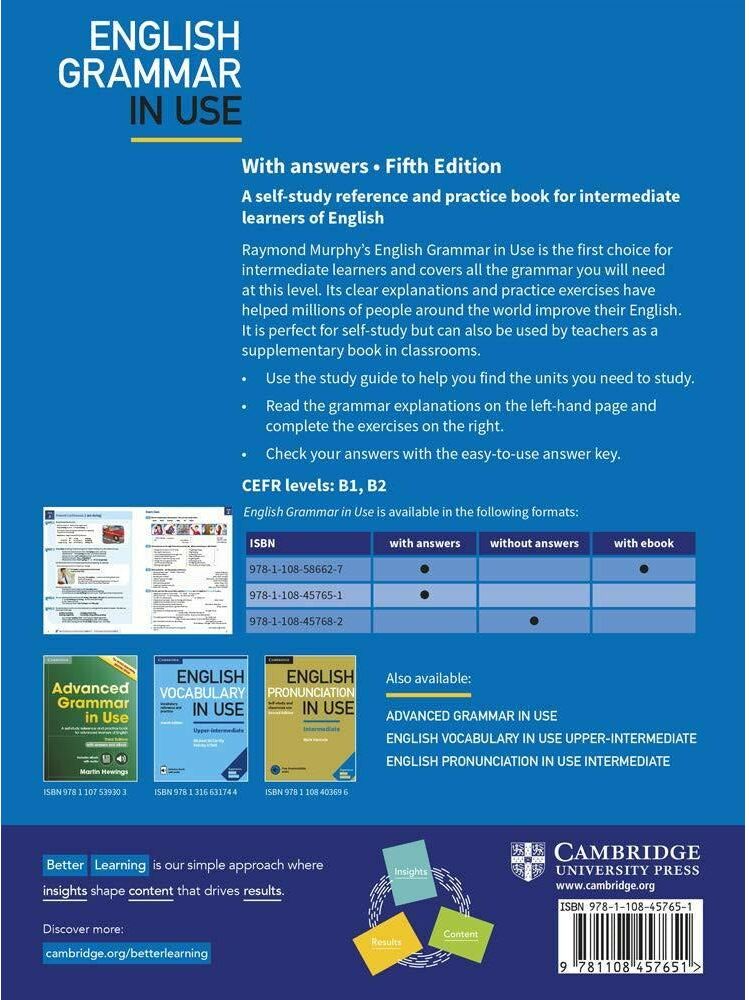
Cambridge University Press English Grammar in Use with Answers by Raymond Murphy – Self-Study Grammar Book for Intermediate LearnersEnglish Grammar in Use with Answers; authored by Raymond Murphy; is the first choice for intermediate (B1-B2) learners and covers all the grammar required at this level. It is a self-study book with simple explanations and lots of practice exercises; and has helped millions of people around the world to communicate in English. It is also trusted by teachers and can be used as a supplementary text in classrooms.12,49 £*Shipping: 2,99 £Secure redirect to the provider
-
Collins Easy Learning Grammar and Punctuation Ages 7-9: Prepare for school with easy home learningDescription. Title :. Grammar and Punctuation Ages 7-9: Prepare for school with easy home learning. Condition: BRAND NEW. Format: Paperback. ISBN: 9780008134228. Combining useful English practice with engaging, colourful illustrations, this Grammar and Punctuation practice book helps to boost your child’s confidence and develop good learning habits for life. Each fun activity is designed to give your child a real sense of achievement.Included in this book:questions that allow children to practise the important skills learned at schoolcolourful activities that make learning fun and motivate children to learn at home helpful tips and answers so that you can support your child’s learning. About the Author:. Colourful and engaging activity books really help children progress at every stage of their learning. With helpful questions and answers, this best-selling range provides reassurance whilst supporting learning at home. Combining useful practice with motivating activities, they help to boost confidence and give children a real sense of achievement.. Title. Grammar and Punctuation Ages 7-9: Prepare for school with easy home learning. Delivery. Content. Reviews3,99 £*Shipping: 2,99 £Secure redirect to the provider


-
Are the ionic lattice and the crystal lattice not the same?
The ionic lattice and the crystal lattice are not the same. A crystal lattice refers to the regular, repeating arrangement of atoms, ions, or molecules in a crystal structure. On the other hand, an ionic lattice specifically refers to the arrangement of positively and negatively charged ions in a crystal structure, where the ions are held together by strong electrostatic forces. While both involve a regular arrangement of particles, the distinction lies in the type of particles and the forces holding them together. **
-
What are lattice vectors?
Lattice vectors are a set of vectors that define the periodic structure of a crystal lattice. They represent the translation symmetry of the lattice and can be used to generate all the points in the lattice by adding integer multiples of the lattice vectors to a reference point. In a 3D crystal lattice, there are typically three lattice vectors that are linearly independent and form the basis for the lattice. The lattice vectors are essential for describing the crystal structure and understanding the physical properties of materials. **
-
What is the difference between an atomic lattice and a molecular lattice?
An atomic lattice is a regular arrangement of atoms in a crystalline solid, where each atom is positioned at specific points in the lattice structure. On the other hand, a molecular lattice is a regular arrangement of molecules in a crystalline solid, where each molecule is positioned at specific points in the lattice structure. In an atomic lattice, the building blocks are individual atoms, while in a molecular lattice, the building blocks are entire molecules. Additionally, atomic lattices are typically found in elemental solids, while molecular lattices are found in molecular solids composed of covalently bonded molecules. **
-
How is lattice energy arranged?
Lattice energy is arranged based on the charges of the ions involved and the distance between them. The greater the charges of the ions, the higher the lattice energy. Additionally, the smaller the distance between the ions, the higher the lattice energy. This is because the closer the ions are, the stronger the electrostatic forces of attraction between them, leading to higher lattice energy. **

What is an ionic lattice?
An ionic lattice is a three-dimensional arrangement of positively and negatively charged ions held together by electrostatic forces. It is a characteristic structure of ionic compounds, where cations and anions are arranged in a repeating pattern to maximize the attraction between opposite charges. The strong electrostatic forces between the ions give ionic lattices high melting and boiling points, as well as making them good conductors of electricity when dissolved in water or melted. **
What is a metal lattice?
A metal lattice refers to the three-dimensional arrangement of metal atoms in a crystalline structure. In a metal lattice, the metal atoms are arranged in a repeating pattern, forming a network of interconnected points. This lattice structure gives metals their characteristic properties such as malleability, ductility, and conductivity. The arrangement of atoms in a metal lattice allows for the movement of electrons, which is why metals are good conductors of electricity and heat. **
Top-Angebote
Products related to Lattice:
-
Collins Easy Learning Spanish Grammar And Practice: Trusted Support For Learning - Non FictionTitle:. Easy Learning Spanish Grammar and Practice Overview:. Master the essential foundations of Spanish with Easy Learning Spanish Grammar and Practice, a comprehensive non-fiction guide engineered to demystify complex grammar rules while building genuine, usable confidence through targeted exercises. This trusted resource moves well beyond passive reading, offering a structured, interactive pathway for learners to understand the mechanics of the language and immediately apply that knowledge. Ideal for individuals navigating the early stages of language acquisition or solidifying intermediate skills, the book functions as a versatile companion that adapts to varied learning styles and paces. By pairing clear, jargon-free explanations with practical application tasks, it ensures that every grammatical concept transforms into functional competence. The content covers critical areas such as verb conjugations, sentence syntax, noun agreement, and descriptive structures, presenting them in a logical sequence that reinforces memory retention. Readers benefit from a design that prioritises clarity over complexity, stripping away intimidating linguistic terminology in favour of straightforward insights that get straight to the point. As a standalone volume, it provides everything needed to tackle the challenges of Spanish grammar independently, making it a highly efficient choice for self-motivated students seeking reliable support for their studies. What Makes This Book Stand Out:. The standout feature of Easy Learning Spanish Grammar and Practice is its relentless integration of the "practice" promise directly into the learning flow. Unlike reference manuals that relegate exercises to the back, this book embeds practice questions seamlessly alongside explanations, allowing readers to test their understanding instantly and receive immediate feedback within the context of each topic. This active recall methodology significantly enhances long-term retention compared to traditional review habits. Furthermore, the book employs an effective scaffolding approach; new rules are introduced only after core principles are secure, preventing cognitive overload and ensuring a steady buildup of competence. The layout further distinguishes itself through high readability standards, featuring generous spacing, helpful navigation aids, and a presentation that respects the learner's time. The text also shines in its ability to contextualise grammar, showing how abstract rules translate into real-world communication, thereby bridging the gap between academic theory and spoken fluency. This balanced focus on both mechanical accuracy and communicative utility gives the book exceptional versatility. It serves equally well as a primary study textbook, a rapid-reference guide for assignment preparation, and a durable portfolio piece that grows more valuable with every chapter reviewed. Who This Book Is Perfect For:. Easy Learning Spanish Grammar and Practice caters to a...12,99 £*Shipping: 2,99 £Secure redirect to the provider
-
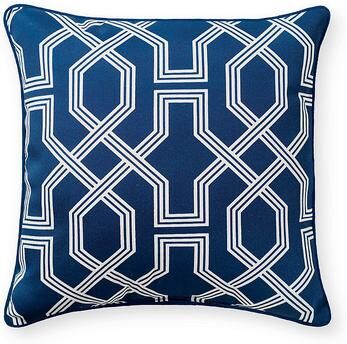
"Lattice Piped Outdoor Pillow - 16"" Square, 16"" Square/Lattice Neptune - Grandin Road"All-weather, fabric outdoor pillow. Quick-dry fabric cover; polyester fill. Fast, easy way to add color, comfort. Durable, stain-resistant. Fade-resistant; vibrant all summer. Select from a wide variety of solid colors to find the perfect fit for...55,20 $*Shipping: 14,95 $Secure redirect to the provider
-
Spelling and Vocabulary practice activities for children ages 6-7 (Year 2). Perfect for Home Learning.: (Scholastic English Skills)Master spelling and vocabulary and build English skills This workbook supports children to develop their spelling and vocabulary skills through fun and engaging activities which will help motivate your child's learning and confidence. A progress chart is also included for children to colour in as chapters are completed, and an introduction chapter on how to use the book. Content is split into: Back to basics; New spellins work: consonants; Focus on vowel sound; Super suffixes; More suffixes; Homophones and tricky words; and Spelling words with apostrophes. Help children feel prepared, capable and ready to tackle new challenges at school. Use at home or in school. Quickly builds confidence through regular, achievable activities that encourage independent learning. Designed to complement the school curriculum, meaning children work at the right level, so nothing feels too hard or too easy. Includes extra notes and tips to reinforce skills.4,99 £*Shipping: 1,99 £Secure redirect to the provider
-
Cambridge University Press English Grammar in Use with Answers by Raymond Murphy – Self-Study Grammar Book for Intermediate LearnersEnglish Grammar in Use with Answers; authored by Raymond Murphy; is the first choice for intermediate (B1-B2) learners and covers all the grammar required at this level. It is a self-study book with simple explanations and lots of practice exercises; and has helped millions of people around the world to communicate in English. It is also trusted by teachers and can be used as a supplementary text in classrooms.12,49 £*Shipping: 2,99 £Secure redirect to the provider
-
Is the ionic lattice and the crystal lattice not the same?
The ionic lattice and the crystal lattice are not the same. The crystal lattice refers to the regular, repeating arrangement of atoms, ions, or molecules in a solid. This arrangement can be found in both ionic and covalent compounds. On the other hand, the ionic lattice specifically refers to the arrangement of ions in an ionic compound, where positively and negatively charged ions are held together by strong electrostatic forces. While both concepts involve the arrangement of particles in a solid, the ionic lattice is a specific type of crystal lattice found in ionic compounds. **
-
How do a metal lattice and a lattice of salts differ?
A metal lattice is made up of positively charged metal ions surrounded by a "sea" of delocalized electrons, which allows for high electrical conductivity. In contrast, a lattice of salts is made up of alternating positively and negatively charged ions held together by ionic bonds. This results in a brittle structure with high melting points and poor electrical conductivity in the solid state. Additionally, the properties of a metal lattice are more malleable and ductile, while a lattice of salts tends to be more brittle and easily fractured. **
-
Are the ionic lattice and the crystal lattice not the same?
The ionic lattice and the crystal lattice are not the same. A crystal lattice refers to the regular, repeating arrangement of atoms, ions, or molecules in a crystal structure. On the other hand, an ionic lattice specifically refers to the arrangement of positively and negatively charged ions in a crystal structure, where the ions are held together by strong electrostatic forces. While both involve a regular arrangement of particles, the distinction lies in the type of particles and the forces holding them together. **
-
What are lattice vectors?
Lattice vectors are a set of vectors that define the periodic structure of a crystal lattice. They represent the translation symmetry of the lattice and can be used to generate all the points in the lattice by adding integer multiples of the lattice vectors to a reference point. In a 3D crystal lattice, there are typically three lattice vectors that are linearly independent and form the basis for the lattice. The lattice vectors are essential for describing the crystal structure and understanding the physical properties of materials. **
Similar search terms for Lattice
-
Collins Easy Learning Grammar and Punctuation Ages 7-9: Prepare for school with easy home learningDescription. Title :. Grammar and Punctuation Ages 7-9: Prepare for school with easy home learning. Condition: BRAND NEW. Format: Paperback. ISBN: 9780008134228. Combining useful English practice with engaging, colourful illustrations, this Grammar and Punctuation practice book helps to boost your child’s confidence and develop good learning habits for life. Each fun activity is designed to give your child a real sense of achievement.Included in this book:questions that allow children to practise the important skills learned at schoolcolourful activities that make learning fun and motivate children to learn at home helpful tips and answers so that you can support your child’s learning. About the Author:. Colourful and engaging activity books really help children progress at every stage of their learning. With helpful questions and answers, this best-selling range provides reassurance whilst supporting learning at home. Combining useful practice with motivating activities, they help to boost confidence and give children a real sense of achievement.. Title. Grammar and Punctuation Ages 7-9: Prepare for school with easy home learning. Delivery. Content. Reviews3,99 £*Shipping: 2,99 £Secure redirect to the provider
-
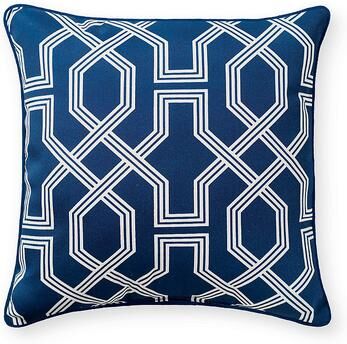
"Lattice Piped Outdoor Pillow - 20"" Square, 20"" Square/Lattice Neptune - Grandin Road"All-weather, fabric outdoor pillow. Quick-dry fabric cover; polyester fill. Fast, easy way to add color, comfort. Durable, stain-resistant. Fade-resistant; vibrant all summer. Select from a wide variety of solid colors to find the perfect fit for...71,20 $*Shipping: 14,95 $Secure redirect to the provider
-
What is the difference between an atomic lattice and a molecular lattice?
An atomic lattice is a regular arrangement of atoms in a crystalline solid, where each atom is positioned at specific points in the lattice structure. On the other hand, a molecular lattice is a regular arrangement of molecules in a crystalline solid, where each molecule is positioned at specific points in the lattice structure. In an atomic lattice, the building blocks are individual atoms, while in a molecular lattice, the building blocks are entire molecules. Additionally, atomic lattices are typically found in elemental solids, while molecular lattices are found in molecular solids composed of covalently bonded molecules. **
-
How is lattice energy arranged?
Lattice energy is arranged based on the charges of the ions involved and the distance between them. The greater the charges of the ions, the higher the lattice energy. Additionally, the smaller the distance between the ions, the higher the lattice energy. This is because the closer the ions are, the stronger the electrostatic forces of attraction between them, leading to higher lattice energy. **
-
What is an ionic lattice?
An ionic lattice is a three-dimensional arrangement of positively and negatively charged ions held together by electrostatic forces. It is a characteristic structure of ionic compounds, where cations and anions are arranged in a repeating pattern to maximize the attraction between opposite charges. The strong electrostatic forces between the ions give ionic lattices high melting and boiling points, as well as making them good conductors of electricity when dissolved in water or melted. **
-
What is a metal lattice?
A metal lattice refers to the three-dimensional arrangement of metal atoms in a crystalline structure. In a metal lattice, the metal atoms are arranged in a repeating pattern, forming a network of interconnected points. This lattice structure gives metals their characteristic properties such as malleability, ductility, and conductivity. The arrangement of atoms in a metal lattice allows for the movement of electrons, which is why metals are good conductors of electricity and heat. **
* All prices are inclusive of VAT and, if applicable, plus shipping costs. The offer information is based on the details provided by the respective shop and is updated through automated processes. Real-time updates do not occur, so deviations can occur in individual cases. ** Note: Parts of this content were created by AI.