Buy 0l.eu ?
We are moving the project
0l.eu .
Are you interested in purchasing the domain
0l.eu ?
domain@kv-gmbh.de · 0541-91531010
Buy 0l.eu ?
How is equity calculated?
Equity is calculated by subtracting the total liabilities of a company from its total assets. In other words, equity represents the ownership interest in a company's assets after all debts and obligations have been paid off. It is a measure of the company's net worth and is often used by investors and analysts to assess the financial health and value of a company. Equity can also be calculated for individuals by subtracting their total liabilities (such as mortgages, loans, and credit card debt) from their total assets (such as savings, investments, and property). **
What is equity capital?
Equity capital refers to the funds that a company raises by selling shares of ownership in the business. These shares represent ownership in the company and entitle the shareholders to a portion of the company's profits and a say in its decision-making processes. Equity capital is a crucial source of long-term funding for a company and can be raised through the sale of common stock or preferred stock. Unlike debt capital, equity capital does not need to be repaid and does not accrue interest, but it does dilute the ownership stake of existing shareholders. **


Similar search terms for Equity
Top-Angebote
Products related to Equity:
-
Authors Equity Superagency: What Could Possibly Go Right With Our AI Future - Non Fiction - PaperbackTitle:. Superagency: What Could Possibly Go Right With Our AI Future Format: Paperback Overview:. In Superagency, Reid Hoffman and journalist Greg Beato offer a bold, human-centered vision of an AI-powered future. This accessible non-fiction work reframes the conversation around artificial intelligence—from fear-based headlines to a practical playbook for expanding human agency in the workplace, in governance, and in everyday decision-making. The authors argue that AI can augment our capabilities, not replace them, and they map a road to responsible, creative collaboration between people and machines. The book blends real-world business insight with thoughtful ethical considerations, delivering clear strategies for leaders, teams, and curious readers who want to participate in shaping a positive trajectory. Designed for non-technical audiences as well as seasoned tech watchers, it explains concepts with tangible examples, case studies, and actionable steps that readers can apply immediately. If you’re seeking a hopeful yet grounded take on how AI can amplify opportunity—without surrendering control—this paperback guides you toward a more confident, proactive relationship with technology. A timely read for entrepreneurs, policy-makers, educators, and everyday readers who want to understand what could go right—and how to make it so. What Makes This Book Stand Out:. Superagency stands out by presenting a constructive, agency-forward narrative at a moment when many AI books focus on risk or hype. Hoffman’s credibility as a tech entrepreneur and LinkedIn co‑founder, paired with Beato’s nuanced reporting, yields a balanced, practical blueprint rather than speculative hype. The authors illuminate how individuals and organizations can harness AI to enhance decision-making, creativity, and collaboration, offering concrete frameworks, decision trees, and leadership guidance that readers can translate into real-world action. It’s non-technical in tone but deliberately aspirational, inviting readers to participate in shaping a future where human ingenuity partners with intelligent systems. The book’s emphasis on governance, ethics, and responsible deployment adds depth, making it a compelling choice for readers who want both inspiration and implementable strategies. Who This Book Is Perfect For:. This paperback is ideal for startup founders, business leaders, managers, and teams exploring AI adoption without needing a coding background. It also appeals to policy makers, educators, and students curious about how AI can augment human work rather than erode it. Readers seeking a hopeful, action-oriented take on technology will appreciate the practical guidance, clear language, and accessible examples. If you’re the kind of reader who devours business books, leadership playbooks, or tech-focused non-fiction that translates high-level ideas into everyday decisions, this title will resonate. It also makes a thoughtful gift for colleagues, mentors, or graduates who...22,00 £*Shipping: 2,99 £Secure redirect to the provider
-
Authors Equity The Simple Path to Wealth: Your Road Map to Financial Independence and a Rich, Free Life by J L CollinsWhat if the path to wealth isn't about timing the market or picking hot stocks, or even about paying someone else to do it for you? What if it’s actually about following a radically simple plan that’s not only easier to implement, but also more lucrative than the alternatives? Drawing from fifty years of investing experience, and born out of a series of letters the author wrote to his daughter, The Simple Path to Wealth has become foundational to the FIRE (Financial Independence, Retire Early) movement, inspiring hundreds of thousands of readers to reimagine their relationship with money and freedom. The real-world success of Collins' approach is documented in Pathfinders, his collection of stories from readers who have transformed their financial lives using his method. Whether you care deeply about money, or never want to think about it at all, you’re living in a culture of spending. Everyone’s telling you that handing over your cash for this gadget, this potion, this lifestyle is the key to happiness. Meanwhile, the reality is that happiness is more likely to come from having the financial freedom to live the life you really want. Whatever your relationship with money, you will be heartened by Collins’ essential insight, which is that simplicity beats complexity every time. This comprehensive guide covers everything from debt elimination to optimizing retirement accounts, all while exposing the marketing myths and investment industry practices that keep most people from building real wealth. Collins shares specific, actionable strategies for both wealth-building and wealth-preservation phases, with a straightforward approach to asset allocation that anyone can implement. Collins' direct, often irreverent style makes complex financial concepts crystal clear, giving readers the tools and confidence to take control of their financial future. More than just another investment book, The Simple Path to Wealth is a blueprint for financial independence – showing readers how to break free from the financial industry’s traps and live life on their own terms.12,99 £*Shipping: 2,99 £Secure redirect to the provider
-
Spelling and Vocabulary practice activities for children ages 6-7 (Year 2). Perfect for Home Learning.: (Scholastic English Skills)Master spelling and vocabulary and build English skills This workbook supports children to develop their spelling and vocabulary skills through fun and engaging activities which will help motivate your child's learning and confidence. A progress chart is also included for children to colour in as chapters are completed, and an introduction chapter on how to use the book. Content is split into: Back to basics; New spellins work: consonants; Focus on vowel sound; Super suffixes; More suffixes; Homophones and tricky words; and Spelling words with apostrophes. Help children feel prepared, capable and ready to tackle new challenges at school. Use at home or in school. Quickly builds confidence through regular, achievable activities that encourage independent learning. Designed to complement the school curriculum, meaning children work at the right level, so nothing feels too hard or too easy. Includes extra notes and tips to reinforce skills.4,99 £*Shipping: 1,99 £Secure redirect to the provider
-
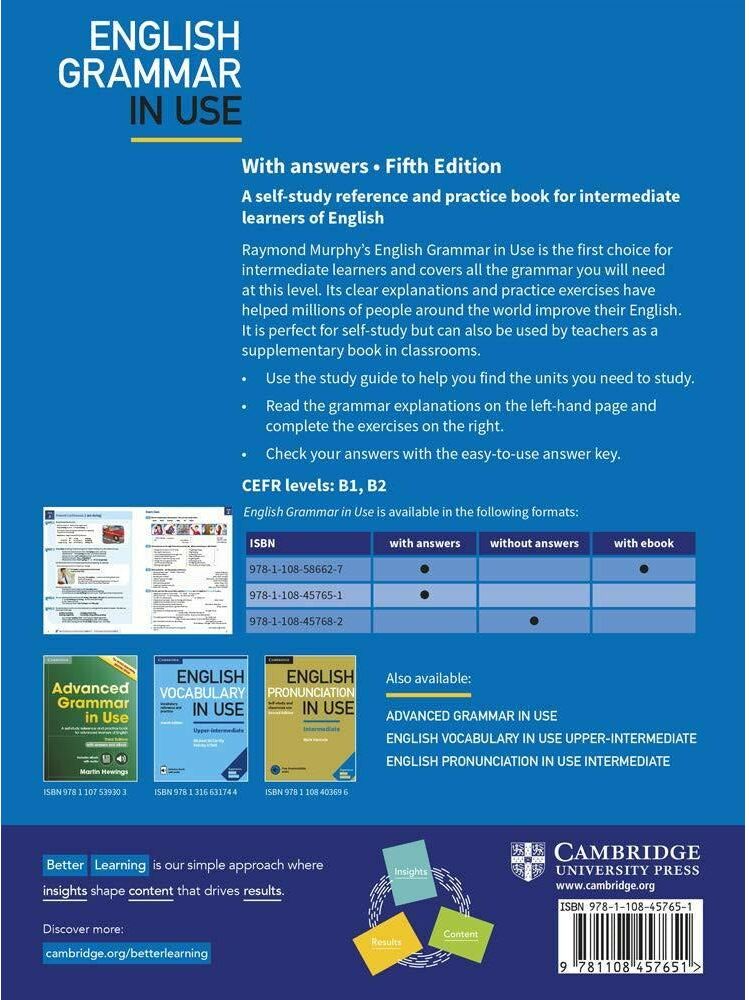
Cambridge University Press English Grammar in Use with Answers by Raymond Murphy – Self-Study Grammar Book for Intermediate LearnersEnglish Grammar in Use with Answers; authored by Raymond Murphy; is the first choice for intermediate (B1-B2) learners and covers all the grammar required at this level. It is a self-study book with simple explanations and lots of practice exercises; and has helped millions of people around the world to communicate in English. It is also trusted by teachers and can be used as a supplementary text in classrooms.12,49 £*Shipping: 2,99 £Secure redirect to the provider


-
What is the accumulated equity?
The accumulated equity is the total value of an asset after subtracting any liabilities or debts associated with it. It represents the ownership interest or value that an individual or entity has in the asset. Accumulated equity can increase over time as the asset appreciates in value or as debts are paid off, resulting in a higher net worth for the owner. It is an important measure of financial health and can be used to determine the overall value of an investment or property. **
-
'Equity type or legal type?'
Equity type refers to the ownership structure of a company, indicating whether it is publicly traded or privately held. Legal type, on the other hand, refers to the legal structure of a business entity, such as a corporation, partnership, or sole proprietorship. While equity type focuses on ownership, legal type is concerned with the legal rights and responsibilities of the entity. Both equity type and legal type are important considerations when determining the structure and governance of a business. **
-
How can one improve equity?
One can improve equity by addressing systemic barriers and biases that contribute to inequality. This can be achieved through policies and practices that promote equal access to opportunities, resources, and representation for all individuals, regardless of their background. Additionally, promoting diversity and inclusion in all aspects of society can help to create a more equitable environment. It is also important to actively listen to and amplify the voices of marginalized communities in decision-making processes. **
-
How do you calculate equity?
Equity is calculated by subtracting the total liabilities of a company from its total assets. The formula for calculating equity is: Equity = Total Assets - Total Liabilities. This calculation gives a measure of the ownership interest in a company, representing the residual value of the assets after all debts and liabilities have been paid off. Equity is an important financial metric that is used to assess the financial health and stability of a company. **


How does depreciation affect equity?
Depreciation reduces the value of assets on the balance sheet, which in turn reduces the overall equity of the company. This is because equity is calculated as the difference between a company's assets and liabilities. As the value of assets decreases due to depreciation, the overall equity of the company also decreases. This can impact the financial health of the company and its ability to attract investors or secure financing. **
What is the difference between equal opportunities, equity of opportunity, and equity of achievement?
Equal opportunities refers to the idea that everyone should have the same access to opportunities, resources, and rights regardless of their background or circumstances. Equity of opportunity goes a step further, aiming to ensure that everyone has the support and resources they need to have an equal chance of success, taking into account individual differences and barriers. Equity of achievement focuses on ensuring that everyone has the same chance of achieving success, regardless of their starting point, and aims to address and eliminate disparities in outcomes. In summary, while equal opportunities focuses on access, equity of opportunity and equity of achievement focus on addressing and eliminating disparities in support and outcomes. **
Top-Angebote
Products related to Equity:
-
Collins Easy Learning Spanish Grammar And Practice: Trusted Support For Learning - Non FictionTitle:. Easy Learning Spanish Grammar and Practice Overview:. Master the essential foundations of Spanish with Easy Learning Spanish Grammar and Practice, a comprehensive non-fiction guide engineered to demystify complex grammar rules while building genuine, usable confidence through targeted exercises. This trusted resource moves well beyond passive reading, offering a structured, interactive pathway for learners to understand the mechanics of the language and immediately apply that knowledge. Ideal for individuals navigating the early stages of language acquisition or solidifying intermediate skills, the book functions as a versatile companion that adapts to varied learning styles and paces. By pairing clear, jargon-free explanations with practical application tasks, it ensures that every grammatical concept transforms into functional competence. The content covers critical areas such as verb conjugations, sentence syntax, noun agreement, and descriptive structures, presenting them in a logical sequence that reinforces memory retention. Readers benefit from a design that prioritises clarity over complexity, stripping away intimidating linguistic terminology in favour of straightforward insights that get straight to the point. As a standalone volume, it provides everything needed to tackle the challenges of Spanish grammar independently, making it a highly efficient choice for self-motivated students seeking reliable support for their studies. What Makes This Book Stand Out:. The standout feature of Easy Learning Spanish Grammar and Practice is its relentless integration of the "practice" promise directly into the learning flow. Unlike reference manuals that relegate exercises to the back, this book embeds practice questions seamlessly alongside explanations, allowing readers to test their understanding instantly and receive immediate feedback within the context of each topic. This active recall methodology significantly enhances long-term retention compared to traditional review habits. Furthermore, the book employs an effective scaffolding approach; new rules are introduced only after core principles are secure, preventing cognitive overload and ensuring a steady buildup of competence. The layout further distinguishes itself through high readability standards, featuring generous spacing, helpful navigation aids, and a presentation that respects the learner's time. The text also shines in its ability to contextualise grammar, showing how abstract rules translate into real-world communication, thereby bridging the gap between academic theory and spoken fluency. This balanced focus on both mechanical accuracy and communicative utility gives the book exceptional versatility. It serves equally well as a primary study textbook, a rapid-reference guide for assignment preparation, and a durable portfolio piece that grows more valuable with every chapter reviewed. Who This Book Is Perfect For:. Easy Learning Spanish Grammar and Practice caters to a...12,99 £*Shipping: 2,99 £Secure redirect to the provider
-
Authors Equity Superagency: What Could Possibly Go Right With Our AI Future - Non Fiction - PaperbackTitle:. Superagency: What Could Possibly Go Right With Our AI Future Format: Paperback Overview:. In Superagency, Reid Hoffman and journalist Greg Beato offer a bold, human-centered vision of an AI-powered future. This accessible non-fiction work reframes the conversation around artificial intelligence—from fear-based headlines to a practical playbook for expanding human agency in the workplace, in governance, and in everyday decision-making. The authors argue that AI can augment our capabilities, not replace them, and they map a road to responsible, creative collaboration between people and machines. The book blends real-world business insight with thoughtful ethical considerations, delivering clear strategies for leaders, teams, and curious readers who want to participate in shaping a positive trajectory. Designed for non-technical audiences as well as seasoned tech watchers, it explains concepts with tangible examples, case studies, and actionable steps that readers can apply immediately. If you’re seeking a hopeful yet grounded take on how AI can amplify opportunity—without surrendering control—this paperback guides you toward a more confident, proactive relationship with technology. A timely read for entrepreneurs, policy-makers, educators, and everyday readers who want to understand what could go right—and how to make it so. What Makes This Book Stand Out:. Superagency stands out by presenting a constructive, agency-forward narrative at a moment when many AI books focus on risk or hype. Hoffman’s credibility as a tech entrepreneur and LinkedIn co‑founder, paired with Beato’s nuanced reporting, yields a balanced, practical blueprint rather than speculative hype. The authors illuminate how individuals and organizations can harness AI to enhance decision-making, creativity, and collaboration, offering concrete frameworks, decision trees, and leadership guidance that readers can translate into real-world action. It’s non-technical in tone but deliberately aspirational, inviting readers to participate in shaping a future where human ingenuity partners with intelligent systems. The book’s emphasis on governance, ethics, and responsible deployment adds depth, making it a compelling choice for readers who want both inspiration and implementable strategies. Who This Book Is Perfect For:. This paperback is ideal for startup founders, business leaders, managers, and teams exploring AI adoption without needing a coding background. It also appeals to policy makers, educators, and students curious about how AI can augment human work rather than erode it. Readers seeking a hopeful, action-oriented take on technology will appreciate the practical guidance, clear language, and accessible examples. If you’re the kind of reader who devours business books, leadership playbooks, or tech-focused non-fiction that translates high-level ideas into everyday decisions, this title will resonate. It also makes a thoughtful gift for colleagues, mentors, or graduates who...22,00 £*Shipping: 2,99 £Secure redirect to the provider
-
Authors Equity The Simple Path to Wealth: Your Road Map to Financial Independence and a Rich, Free Life by J L CollinsWhat if the path to wealth isn't about timing the market or picking hot stocks, or even about paying someone else to do it for you? What if it’s actually about following a radically simple plan that’s not only easier to implement, but also more lucrative than the alternatives? Drawing from fifty years of investing experience, and born out of a series of letters the author wrote to his daughter, The Simple Path to Wealth has become foundational to the FIRE (Financial Independence, Retire Early) movement, inspiring hundreds of thousands of readers to reimagine their relationship with money and freedom. The real-world success of Collins' approach is documented in Pathfinders, his collection of stories from readers who have transformed their financial lives using his method. Whether you care deeply about money, or never want to think about it at all, you’re living in a culture of spending. Everyone’s telling you that handing over your cash for this gadget, this potion, this lifestyle is the key to happiness. Meanwhile, the reality is that happiness is more likely to come from having the financial freedom to live the life you really want. Whatever your relationship with money, you will be heartened by Collins’ essential insight, which is that simplicity beats complexity every time. This comprehensive guide covers everything from debt elimination to optimizing retirement accounts, all while exposing the marketing myths and investment industry practices that keep most people from building real wealth. Collins shares specific, actionable strategies for both wealth-building and wealth-preservation phases, with a straightforward approach to asset allocation that anyone can implement. Collins' direct, often irreverent style makes complex financial concepts crystal clear, giving readers the tools and confidence to take control of their financial future. More than just another investment book, The Simple Path to Wealth is a blueprint for financial independence – showing readers how to break free from the financial industry’s traps and live life on their own terms.12,99 £*Shipping: 2,99 £Secure redirect to the provider
-
How is equity calculated?
Equity is calculated by subtracting the total liabilities of a company from its total assets. In other words, equity represents the ownership interest in a company's assets after all debts and obligations have been paid off. It is a measure of the company's net worth and is often used by investors and analysts to assess the financial health and value of a company. Equity can also be calculated for individuals by subtracting their total liabilities (such as mortgages, loans, and credit card debt) from their total assets (such as savings, investments, and property). **
-
What is equity capital?
Equity capital refers to the funds that a company raises by selling shares of ownership in the business. These shares represent ownership in the company and entitle the shareholders to a portion of the company's profits and a say in its decision-making processes. Equity capital is a crucial source of long-term funding for a company and can be raised through the sale of common stock or preferred stock. Unlike debt capital, equity capital does not need to be repaid and does not accrue interest, but it does dilute the ownership stake of existing shareholders. **
-
What is the accumulated equity?
The accumulated equity is the total value of an asset after subtracting any liabilities or debts associated with it. It represents the ownership interest or value that an individual or entity has in the asset. Accumulated equity can increase over time as the asset appreciates in value or as debts are paid off, resulting in a higher net worth for the owner. It is an important measure of financial health and can be used to determine the overall value of an investment or property. **
-
'Equity type or legal type?'
Equity type refers to the ownership structure of a company, indicating whether it is publicly traded or privately held. Legal type, on the other hand, refers to the legal structure of a business entity, such as a corporation, partnership, or sole proprietorship. While equity type focuses on ownership, legal type is concerned with the legal rights and responsibilities of the entity. Both equity type and legal type are important considerations when determining the structure and governance of a business. **
Similar search terms for Equity
-
Spelling and Vocabulary practice activities for children ages 6-7 (Year 2). Perfect for Home Learning.: (Scholastic English Skills)Master spelling and vocabulary and build English skills This workbook supports children to develop their spelling and vocabulary skills through fun and engaging activities which will help motivate your child's learning and confidence. A progress chart is also included for children to colour in as chapters are completed, and an introduction chapter on how to use the book. Content is split into: Back to basics; New spellins work: consonants; Focus on vowel sound; Super suffixes; More suffixes; Homophones and tricky words; and Spelling words with apostrophes. Help children feel prepared, capable and ready to tackle new challenges at school. Use at home or in school. Quickly builds confidence through regular, achievable activities that encourage independent learning. Designed to complement the school curriculum, meaning children work at the right level, so nothing feels too hard or too easy. Includes extra notes and tips to reinforce skills.4,99 £*Shipping: 1,99 £Secure redirect to the provider
-
Cambridge University Press English Grammar in Use with Answers by Raymond Murphy – Self-Study Grammar Book for Intermediate LearnersEnglish Grammar in Use with Answers; authored by Raymond Murphy; is the first choice for intermediate (B1-B2) learners and covers all the grammar required at this level. It is a self-study book with simple explanations and lots of practice exercises; and has helped millions of people around the world to communicate in English. It is also trusted by teachers and can be used as a supplementary text in classrooms.12,49 £*Shipping: 2,99 £Secure redirect to the provider
-
Collins Easy Learning Grammar and Punctuation Ages 7-9: Prepare for school with easy home learningDescription. Title :. Grammar and Punctuation Ages 7-9: Prepare for school with easy home learning. Condition: BRAND NEW. Format: Paperback. ISBN: 9780008134228. Combining useful English practice with engaging, colourful illustrations, this Grammar and Punctuation practice book helps to boost your child’s confidence and develop good learning habits for life. Each fun activity is designed to give your child a real sense of achievement.Included in this book:questions that allow children to practise the important skills learned at schoolcolourful activities that make learning fun and motivate children to learn at home helpful tips and answers so that you can support your child’s learning. About the Author:. Colourful and engaging activity books really help children progress at every stage of their learning. With helpful questions and answers, this best-selling range provides reassurance whilst supporting learning at home. Combining useful practice with motivating activities, they help to boost confidence and give children a real sense of achievement.. Title. Grammar and Punctuation Ages 7-9: Prepare for school with easy home learning. Delivery. Content. Reviews3,99 £*Shipping: 2,99 £Secure redirect to the provider
-
Collins Easy Learning English Grammar And Punctuation 1 By Collins Education - Non Fiction - PaperbackTitle:. Collins Easy Learning English Grammar And Punctuation 1 Format: Paperback Overview:. The Collins Easy Learning English Grammar And Punctuation 1 delivers a focused, highly practical introduction to the foundational rules that govern effective written English. Published by Collins Education, this volume serves as the first entry in a widely respected instructional series designed to break down complex linguistic concepts into manageable, easy-to-follow lessons. Rather than presenting dense theoretical lectures, the book adopts a structured, activity-driven approach that guides readers through essential grammar topics, punctuation conventions, clause construction, and common syntactical patterns. Each chapter pairs clear explanations with targeted exercises that reinforce understanding through immediate application. The layout prioritises readability, using spacious margins, defined headings, and visual cues that make self-directed study straightforward. Whether you are preparing for formal assessments, rebuilding foundational literacy skills after years away from academia, or simply aiming to eliminate recurring errors in everyday documents, this guide provides a reliable pathway to clearer, more confident writing. By combining curriculum-aligned content with proven pedagogy, the book bridges the gap between passive reading and active mastery, ensuring that every lesson translates directly into improved communication habits outside the page. What Makes This Book Stand Out:. Unlike traditional grammar textbooks that overwhelm readers with exhaustive terminology and rigid formatting, this volume thrives on accessibility and progressive skill building. The standout feature is its deliberate pacing: each rule is introduced through a concise explanation, immediately followed by contextual examples that mirror real-world usage. Practice tasks are embedded throughout rather than quarantined at the end, allowing readers to test comprehension in the moment and receive structured feedback loops. The editorial design intentionally avoids decorative clutter, keeping attention fixed on syntax, punctuation marks, sentence boundaries, and error correction strategies. Every chapter concludes with review checkpoints that help learners identify weak spots before advancing, creating a cumulative mastery model instead of fragmented studying. The paperback format remains deliberately compact without sacrificing depth, striking a balance between portability and comprehensive coverage. This combination of cognitive scaffolding, clear typographic hierarchy, and purposeful exercise sequencing transforms what could easily feel mechanical into an engaging, results-oriented study tool. It respects the reader’s time, acknowledges typical stumbling blocks, and replaces confusion with repeatable frameworks that stick. Who This Book Is Perfect For:. This resource is ideally suited for secondary school students navigating National Curriculum expectations, particularly...7,99 £*Shipping: 2,99 £Secure redirect to the provider
-
How can one improve equity?
One can improve equity by addressing systemic barriers and biases that contribute to inequality. This can be achieved through policies and practices that promote equal access to opportunities, resources, and representation for all individuals, regardless of their background. Additionally, promoting diversity and inclusion in all aspects of society can help to create a more equitable environment. It is also important to actively listen to and amplify the voices of marginalized communities in decision-making processes. **
-
How do you calculate equity?
Equity is calculated by subtracting the total liabilities of a company from its total assets. The formula for calculating equity is: Equity = Total Assets - Total Liabilities. This calculation gives a measure of the ownership interest in a company, representing the residual value of the assets after all debts and liabilities have been paid off. Equity is an important financial metric that is used to assess the financial health and stability of a company. **
-
How does depreciation affect equity?
Depreciation reduces the value of assets on the balance sheet, which in turn reduces the overall equity of the company. This is because equity is calculated as the difference between a company's assets and liabilities. As the value of assets decreases due to depreciation, the overall equity of the company also decreases. This can impact the financial health of the company and its ability to attract investors or secure financing. **
-
What is the difference between equal opportunities, equity of opportunity, and equity of achievement?
Equal opportunities refers to the idea that everyone should have the same access to opportunities, resources, and rights regardless of their background or circumstances. Equity of opportunity goes a step further, aiming to ensure that everyone has the support and resources they need to have an equal chance of success, taking into account individual differences and barriers. Equity of achievement focuses on ensuring that everyone has the same chance of achieving success, regardless of their starting point, and aims to address and eliminate disparities in outcomes. In summary, while equal opportunities focuses on access, equity of opportunity and equity of achievement focus on addressing and eliminating disparities in support and outcomes. **
* All prices are inclusive of VAT and, if applicable, plus shipping costs. The offer information is based on the details provided by the respective shop and is updated through automated processes. Real-time updates do not occur, so deviations can occur in individual cases. ** Note: Parts of this content were created by AI.