Buy 0l.eu ?
We are moving the project
0l.eu .
Are you interested in purchasing the domain
0l.eu ?
domain@kv-gmbh.de · 0541-91531010
Buy 0l.eu ?
Should one learn grammar or vocabulary first when learning Japanese?
When learning Japanese, it is generally recommended to start with vocabulary before diving into grammar. Building a strong vocabulary base will help you understand and communicate better in the language. Once you have a good grasp of basic vocabulary, you can then focus on learning grammar rules to structure your sentences correctly. Ultimately, a balance of both vocabulary and grammar is essential for mastering Japanese. **
What are some good books for learning French, especially for grammar and vocabulary?
Some good books for learning French grammar and vocabulary include "Practice Makes Perfect: Complete French Grammar" by Annie Heminway, "Easy French Step-by-Step" by Myrna Bell Rochester, and "Vocabulary Builder: French" by Harriette Lanzer. These books provide comprehensive explanations of grammar rules and offer plenty of exercises to practice and reinforce your understanding. Additionally, "501 French Verbs" by Christopher Kendris is a valuable resource for learning and mastering French verb conjugations. **

Similar search terms for Grammar
Top-Angebote
Products related to Grammar:
-
Collins Easy Learning Grammar and Punctuation Ages 7-9: Prepare for school with easy home learningDescription. Title :. Grammar and Punctuation Ages 7-9: Prepare for school with easy home learning. Condition: BRAND NEW. Format: Paperback. ISBN: 9780008134228. Combining useful English practice with engaging, colourful illustrations, this Grammar and Punctuation practice book helps to boost your child’s confidence and develop good learning habits for life. Each fun activity is designed to give your child a real sense of achievement.Included in this book:questions that allow children to practise the important skills learned at schoolcolourful activities that make learning fun and motivate children to learn at home helpful tips and answers so that you can support your child’s learning. About the Author:. Colourful and engaging activity books really help children progress at every stage of their learning. With helpful questions and answers, this best-selling range provides reassurance whilst supporting learning at home. Combining useful practice with motivating activities, they help to boost confidence and give children a real sense of achievement.. Title. Grammar and Punctuation Ages 7-9: Prepare for school with easy home learning. Delivery. Content. Reviews3,99 £*Shipping: 2,99 £Secure redirect to the provider
-
Collins Easy Learning English Grammar And Punctuation 1 By Collins Education - Non Fiction - PaperbackTitle:. Collins Easy Learning English Grammar And Punctuation 1 Format: Paperback Overview:. The Collins Easy Learning English Grammar And Punctuation 1 delivers a focused, highly practical introduction to the foundational rules that govern effective written English. Published by Collins Education, this volume serves as the first entry in a widely respected instructional series designed to break down complex linguistic concepts into manageable, easy-to-follow lessons. Rather than presenting dense theoretical lectures, the book adopts a structured, activity-driven approach that guides readers through essential grammar topics, punctuation conventions, clause construction, and common syntactical patterns. Each chapter pairs clear explanations with targeted exercises that reinforce understanding through immediate application. The layout prioritises readability, using spacious margins, defined headings, and visual cues that make self-directed study straightforward. Whether you are preparing for formal assessments, rebuilding foundational literacy skills after years away from academia, or simply aiming to eliminate recurring errors in everyday documents, this guide provides a reliable pathway to clearer, more confident writing. By combining curriculum-aligned content with proven pedagogy, the book bridges the gap between passive reading and active mastery, ensuring that every lesson translates directly into improved communication habits outside the page. What Makes This Book Stand Out:. Unlike traditional grammar textbooks that overwhelm readers with exhaustive terminology and rigid formatting, this volume thrives on accessibility and progressive skill building. The standout feature is its deliberate pacing: each rule is introduced through a concise explanation, immediately followed by contextual examples that mirror real-world usage. Practice tasks are embedded throughout rather than quarantined at the end, allowing readers to test comprehension in the moment and receive structured feedback loops. The editorial design intentionally avoids decorative clutter, keeping attention fixed on syntax, punctuation marks, sentence boundaries, and error correction strategies. Every chapter concludes with review checkpoints that help learners identify weak spots before advancing, creating a cumulative mastery model instead of fragmented studying. The paperback format remains deliberately compact without sacrificing depth, striking a balance between portability and comprehensive coverage. This combination of cognitive scaffolding, clear typographic hierarchy, and purposeful exercise sequencing transforms what could easily feel mechanical into an engaging, results-oriented study tool. It respects the reader’s time, acknowledges typical stumbling blocks, and replaces confusion with repeatable frameworks that stick. Who This Book Is Perfect For:. This resource is ideally suited for secondary school students navigating National Curriculum expectations, particularly...7,99 £*Shipping: 2,99 £Secure redirect to the provider
-
Junior Illustrated Grammar and Punctuation Children by Jane BinghamDescription:. Condition: BRAND NEW. Format: Paperback. An easy-to-use guide to grammar and punctuation with sections on nouns, pronouns, verbs, apostrophes, quotation marks and more. Clear explanations, fun illustrations and lively example sentences will help children develop their writing style and skills and there are short quizzes to test their knowledge. A useful reference book for home and school.. Title. Junior Illustrated Grammar and Punctuation Children by Jane Bingham. Delivery. Content. Reviews99,99 £*Shipping: 0,00 £Secure redirect to the provider
-
CGP Books CGP GCSE SP&G; Study Guide, KS3 Spelling Punctuation & Grammar Workbook 2 Books Collection SetDescription. Titles in the Set:. GCSE Spelling, Punctuation and Grammar The Study Guide. KS3 Spelling, Punctuation & Grammar The Workbook. Condition: BRAND NEW. Format: Paperback. ISBN: 9781200780015. GCSE Spelling, Punctuation and Grammar The Study Guide:. In Grade 9-1 GCSE English Literature, Geography, History and RS, 5% of the marks are now awarded for spelling, punctuation and grammar. This CGP book is a clear and succinct guide to avoiding common SPaG mistakes, with plenty of useful advice for picking up as many marks as possible. There are also practice questions for each topic to test students’ understanding of the important points.. KS3 Spelling, Punctuation & Grammar The Workbook:. This Workbook is packed with practice questions for Key Stage Three Spelling, Punctuation and Grammar - perfect for helping students master all the important skills! Plus, all the answers are included at the back of the book.. Title. CGP GCSE SP&G; Study Guide, KS3 Spelling Punctuation & Grammar Workbook 2 Books Collection Set. Delivery. Content. Reviews99,99 £*Shipping: 0,00 £Secure redirect to the provider


-
What is the difference between vocabulary and grammar?
Vocabulary refers to the words and their meanings in a language, while grammar refers to the rules and structure of how those words are used to form sentences and convey meaning. In other words, vocabulary is the collection of words a person knows, while grammar is the system that governs how those words are put together to create meaningful communication. Understanding vocabulary helps with understanding the meaning of individual words, while understanding grammar helps with understanding how those words are used to form coherent sentences and express ideas. **
-
Should one learn vocabulary first and then grammar?
It is generally recommended to learn both vocabulary and grammar simultaneously. While building vocabulary can help in understanding and expressing ideas, grammar provides the structure and rules for forming coherent sentences. Learning them together can help in understanding how words are used in context and how to form correct sentences. Additionally, practicing both vocabulary and grammar together can lead to a more balanced and comprehensive language learning experience. **
-
How can one improve spelling, grammar, and vocabulary?
One can improve spelling, grammar, and vocabulary by reading extensively, as exposure to well-written material can help internalize correct spelling and grammar. Additionally, practicing writing and seeking feedback can help identify and correct errors. Using tools such as spell check and grammar check can also be helpful in identifying and correcting mistakes. Finally, regularly learning new words and their meanings through reading, word games, and vocabulary-building exercises can help expand one's vocabulary. **
-
Which language has the most difficult grammar?
Determining which language has the most difficult grammar is subjective and can vary depending on the individual's native language and learning style. However, languages such as Arabic, Russian, and Japanese are often considered to have complex grammar structures due to their intricate verb conjugations, noun cases, and sentence formations. These languages may pose challenges for learners due to their unique features and rules that differ significantly from English or other widely spoken languages. Ultimately, the difficulty of a language's grammar is relative and can be influenced by various factors. **


Which language is closest to German grammar?
Dutch is the language that is closest to German grammar. Both languages are part of the West Germanic language family and share many similarities in terms of grammar, vocabulary, and sentence structure. Speakers of German and Dutch can often understand each other to some extent due to these similarities. **
Does gender-neutral language complicate German grammar?
Yes, gender-neutral language can complicate German grammar because the German language is heavily gendered, with different articles, adjectives, and pronouns for masculine, feminine, and neuter nouns. Introducing gender-neutral language requires finding alternative ways to express oneself without relying on traditional gendered forms, which can be challenging. However, efforts are being made to develop inclusive language guidelines and create new gender-neutral forms to address this issue. **
Top-Angebote
Products related to Grammar:
-
Collins Easy Learning Spanish Grammar And Practice: Trusted Support For Learning - Non FictionTitle:. Easy Learning Spanish Grammar and Practice Overview:. Master the essential foundations of Spanish with Easy Learning Spanish Grammar and Practice, a comprehensive non-fiction guide engineered to demystify complex grammar rules while building genuine, usable confidence through targeted exercises. This trusted resource moves well beyond passive reading, offering a structured, interactive pathway for learners to understand the mechanics of the language and immediately apply that knowledge. Ideal for individuals navigating the early stages of language acquisition or solidifying intermediate skills, the book functions as a versatile companion that adapts to varied learning styles and paces. By pairing clear, jargon-free explanations with practical application tasks, it ensures that every grammatical concept transforms into functional competence. The content covers critical areas such as verb conjugations, sentence syntax, noun agreement, and descriptive structures, presenting them in a logical sequence that reinforces memory retention. Readers benefit from a design that prioritises clarity over complexity, stripping away intimidating linguistic terminology in favour of straightforward insights that get straight to the point. As a standalone volume, it provides everything needed to tackle the challenges of Spanish grammar independently, making it a highly efficient choice for self-motivated students seeking reliable support for their studies. What Makes This Book Stand Out:. The standout feature of Easy Learning Spanish Grammar and Practice is its relentless integration of the "practice" promise directly into the learning flow. Unlike reference manuals that relegate exercises to the back, this book embeds practice questions seamlessly alongside explanations, allowing readers to test their understanding instantly and receive immediate feedback within the context of each topic. This active recall methodology significantly enhances long-term retention compared to traditional review habits. Furthermore, the book employs an effective scaffolding approach; new rules are introduced only after core principles are secure, preventing cognitive overload and ensuring a steady buildup of competence. The layout further distinguishes itself through high readability standards, featuring generous spacing, helpful navigation aids, and a presentation that respects the learner's time. The text also shines in its ability to contextualise grammar, showing how abstract rules translate into real-world communication, thereby bridging the gap between academic theory and spoken fluency. This balanced focus on both mechanical accuracy and communicative utility gives the book exceptional versatility. It serves equally well as a primary study textbook, a rapid-reference guide for assignment preparation, and a durable portfolio piece that grows more valuable with every chapter reviewed. Who This Book Is Perfect For:. Easy Learning Spanish Grammar and Practice caters to a...12,99 £*Shipping: 2,99 £Secure redirect to the provider
-
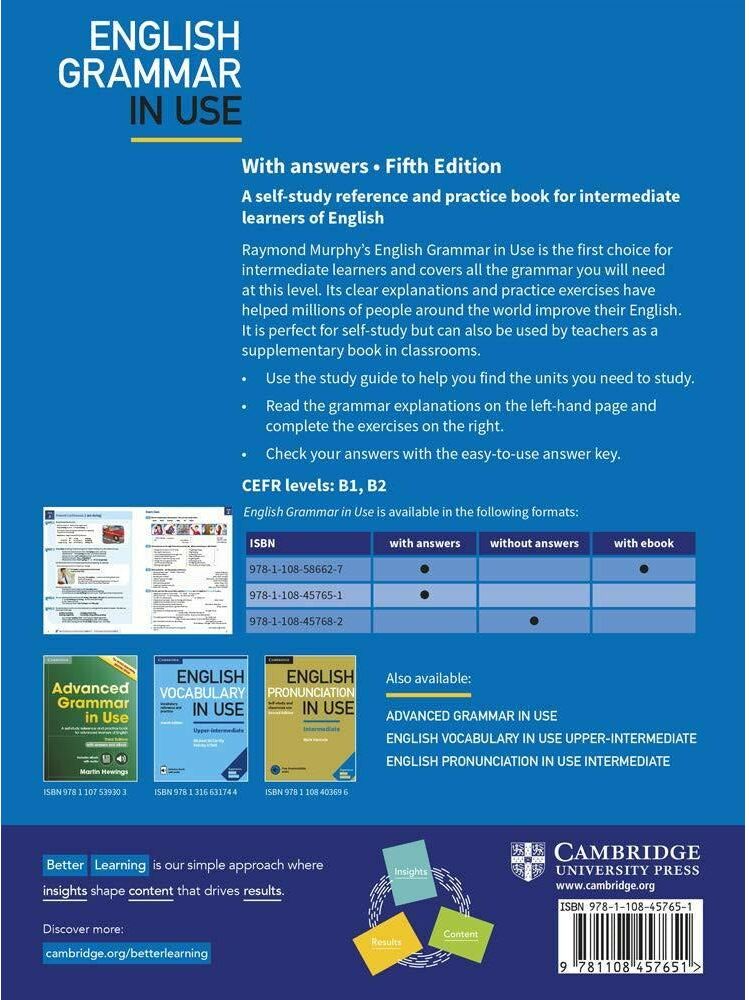
Cambridge University Press English Grammar in Use with Answers by Raymond Murphy – Self-Study Grammar Book for Intermediate LearnersEnglish Grammar in Use with Answers; authored by Raymond Murphy; is the first choice for intermediate (B1-B2) learners and covers all the grammar required at this level. It is a self-study book with simple explanations and lots of practice exercises; and has helped millions of people around the world to communicate in English. It is also trusted by teachers and can be used as a supplementary text in classrooms.12,49 £*Shipping: 2,99 £Secure redirect to the provider
-
Collins Easy Learning Grammar and Punctuation Ages 7-9: Prepare for school with easy home learningDescription. Title :. Grammar and Punctuation Ages 7-9: Prepare for school with easy home learning. Condition: BRAND NEW. Format: Paperback. ISBN: 9780008134228. Combining useful English practice with engaging, colourful illustrations, this Grammar and Punctuation practice book helps to boost your child’s confidence and develop good learning habits for life. Each fun activity is designed to give your child a real sense of achievement.Included in this book:questions that allow children to practise the important skills learned at schoolcolourful activities that make learning fun and motivate children to learn at home helpful tips and answers so that you can support your child’s learning. About the Author:. Colourful and engaging activity books really help children progress at every stage of their learning. With helpful questions and answers, this best-selling range provides reassurance whilst supporting learning at home. Combining useful practice with motivating activities, they help to boost confidence and give children a real sense of achievement.. Title. Grammar and Punctuation Ages 7-9: Prepare for school with easy home learning. Delivery. Content. Reviews3,99 £*Shipping: 2,99 £Secure redirect to the provider
-
Collins Easy Learning English Grammar And Punctuation 1 By Collins Education - Non Fiction - PaperbackTitle:. Collins Easy Learning English Grammar And Punctuation 1 Format: Paperback Overview:. The Collins Easy Learning English Grammar And Punctuation 1 delivers a focused, highly practical introduction to the foundational rules that govern effective written English. Published by Collins Education, this volume serves as the first entry in a widely respected instructional series designed to break down complex linguistic concepts into manageable, easy-to-follow lessons. Rather than presenting dense theoretical lectures, the book adopts a structured, activity-driven approach that guides readers through essential grammar topics, punctuation conventions, clause construction, and common syntactical patterns. Each chapter pairs clear explanations with targeted exercises that reinforce understanding through immediate application. The layout prioritises readability, using spacious margins, defined headings, and visual cues that make self-directed study straightforward. Whether you are preparing for formal assessments, rebuilding foundational literacy skills after years away from academia, or simply aiming to eliminate recurring errors in everyday documents, this guide provides a reliable pathway to clearer, more confident writing. By combining curriculum-aligned content with proven pedagogy, the book bridges the gap between passive reading and active mastery, ensuring that every lesson translates directly into improved communication habits outside the page. What Makes This Book Stand Out:. Unlike traditional grammar textbooks that overwhelm readers with exhaustive terminology and rigid formatting, this volume thrives on accessibility and progressive skill building. The standout feature is its deliberate pacing: each rule is introduced through a concise explanation, immediately followed by contextual examples that mirror real-world usage. Practice tasks are embedded throughout rather than quarantined at the end, allowing readers to test comprehension in the moment and receive structured feedback loops. The editorial design intentionally avoids decorative clutter, keeping attention fixed on syntax, punctuation marks, sentence boundaries, and error correction strategies. Every chapter concludes with review checkpoints that help learners identify weak spots before advancing, creating a cumulative mastery model instead of fragmented studying. The paperback format remains deliberately compact without sacrificing depth, striking a balance between portability and comprehensive coverage. This combination of cognitive scaffolding, clear typographic hierarchy, and purposeful exercise sequencing transforms what could easily feel mechanical into an engaging, results-oriented study tool. It respects the reader’s time, acknowledges typical stumbling blocks, and replaces confusion with repeatable frameworks that stick. Who This Book Is Perfect For:. This resource is ideally suited for secondary school students navigating National Curriculum expectations, particularly...7,99 £*Shipping: 2,99 £Secure redirect to the provider
-
Should one learn grammar or vocabulary first when learning Japanese?
When learning Japanese, it is generally recommended to start with vocabulary before diving into grammar. Building a strong vocabulary base will help you understand and communicate better in the language. Once you have a good grasp of basic vocabulary, you can then focus on learning grammar rules to structure your sentences correctly. Ultimately, a balance of both vocabulary and grammar is essential for mastering Japanese. **
-
What are some good books for learning French, especially for grammar and vocabulary?
Some good books for learning French grammar and vocabulary include "Practice Makes Perfect: Complete French Grammar" by Annie Heminway, "Easy French Step-by-Step" by Myrna Bell Rochester, and "Vocabulary Builder: French" by Harriette Lanzer. These books provide comprehensive explanations of grammar rules and offer plenty of exercises to practice and reinforce your understanding. Additionally, "501 French Verbs" by Christopher Kendris is a valuable resource for learning and mastering French verb conjugations. **
-
What is the difference between vocabulary and grammar?
Vocabulary refers to the words and their meanings in a language, while grammar refers to the rules and structure of how those words are used to form sentences and convey meaning. In other words, vocabulary is the collection of words a person knows, while grammar is the system that governs how those words are put together to create meaningful communication. Understanding vocabulary helps with understanding the meaning of individual words, while understanding grammar helps with understanding how those words are used to form coherent sentences and express ideas. **
-
Should one learn vocabulary first and then grammar?
It is generally recommended to learn both vocabulary and grammar simultaneously. While building vocabulary can help in understanding and expressing ideas, grammar provides the structure and rules for forming coherent sentences. Learning them together can help in understanding how words are used in context and how to form correct sentences. Additionally, practicing both vocabulary and grammar together can lead to a more balanced and comprehensive language learning experience. **
Similar search terms for Grammar
-
Junior Illustrated Grammar and Punctuation Children by Jane BinghamDescription:. Condition: BRAND NEW. Format: Paperback. An easy-to-use guide to grammar and punctuation with sections on nouns, pronouns, verbs, apostrophes, quotation marks and more. Clear explanations, fun illustrations and lively example sentences will help children develop their writing style and skills and there are short quizzes to test their knowledge. A useful reference book for home and school.. Title. Junior Illustrated Grammar and Punctuation Children by Jane Bingham. Delivery. Content. Reviews99,99 £*Shipping: 0,00 £Secure redirect to the provider
-
CGP Books CGP GCSE SP&G; Study Guide, KS3 Spelling Punctuation & Grammar Workbook 2 Books Collection SetDescription. Titles in the Set:. GCSE Spelling, Punctuation and Grammar The Study Guide. KS3 Spelling, Punctuation & Grammar The Workbook. Condition: BRAND NEW. Format: Paperback. ISBN: 9781200780015. GCSE Spelling, Punctuation and Grammar The Study Guide:. In Grade 9-1 GCSE English Literature, Geography, History and RS, 5% of the marks are now awarded for spelling, punctuation and grammar. This CGP book is a clear and succinct guide to avoiding common SPaG mistakes, with plenty of useful advice for picking up as many marks as possible. There are also practice questions for each topic to test students’ understanding of the important points.. KS3 Spelling, Punctuation & Grammar The Workbook:. This Workbook is packed with practice questions for Key Stage Three Spelling, Punctuation and Grammar - perfect for helping students master all the important skills! Plus, all the answers are included at the back of the book.. Title. CGP GCSE SP&G; Study Guide, KS3 Spelling Punctuation & Grammar Workbook 2 Books Collection Set. Delivery. Content. Reviews99,99 £*Shipping: 0,00 £Secure redirect to the provider
-
Kyle Books Grammar For Grown Ups: Essential Guide To English Writing - Non Fiction - PaperbackTitle:. Grammar for Grown-ups: Everything you need to know but never learnt in school Format: Paperback Overview:. Mastering the nuances of written communication is one of the most significant advantages an adult can cultivate in both their professional and personal life. 'Grammar for Grown-ups: Everything you need to know but never learnt in school' serves as the definitive bridge across the often frustrating gap between traditional classroom learning and the demanding reality of everyday English writing. As an Essential Guide to English Writing, this volume is crafted specifically for mature readers who recognise that while school may have introduced basic concepts, true mastery requires a deeper, more practical understanding tailored to real-world application. The book addresses the subtle complexities, frequent pitfalls, and stylistic choices that dictate how clearly and persuasively an individual can convey their message. By focusing on the functional aspects of grammar that truly matter outside the exam hall, this paperback volume empowers readers to eliminate uncertainty and communicate with precision. Many adults find themselves relying on autocorrect or second-guessing their phrasing when the stakes are high; this guide eliminates that hesitation by delivering straightforward, applicable wisdom without unnecessary academic jargon. It reinforces the idea that great writing is not about memorising obscure rules but about building trust through clarity. From enhancing the impact of daily emails to refining creative projects, the principles within are designed to be immediately useful. This edition stands as a robust resource for anyone eager to transform potential awkwardness into eloquence, ensuring that every written interaction reflects the sophistication and attention to detail that adulthood demands. What Makes This Book Stand Out:. The distinction of 'Grammar for Grown-ups' lies in its candid approach to the educational shortcomings that many learners face. Unlike standard academic textbooks that can feel detached from daily use, this guide honours its subtitle by tackling the very elements that seem to vanish after the school gates close. The standout philosophy prioritises practical utility over pedantic rigidity, recognising that grammar is ultimately a tool for effective connection rather than a set of arbitrary restrictions meant to confuse. Readers quickly discover that the focus shifts towards making informed decisions about usage, punctuation, and syntax in a manner that supports readability and intent. This perspective demystifies what many consider difficult rules, reframing them as strategies for clarity and respect for the reader's time. Additionally, the book addresses the modern evolution of language, acknowledging how digital platforms and informal messaging require adaptability. It helps grown-ups navigate these shifting landscapes without sacrificing core standards, striking an optimal balance between flexibility and...12,99 £*Shipping: 2,99 £Secure redirect to the provider
-
English Grammar in Use With Answers for Intermediate Learners by Raymond Murphy - Non Fiction - PaperbackTitle:. English Grammar In Use With Answers For Intermediate Learners By Raymond Murphy Condition: BRAND NEW. Format: Paperback. ISBN: 9783125354241 Overview:. Raymond Murphy's English Grammar in Use with Answers is the definitive self-study reference for intermediate learners working at CEFR levels B1 to B2. In this paperback, clear grammar explanations sit beside abundant practice, guiding you from fundamental rules to real-life usage with growing confidence. It is designed for solo study as well as classroom support, offering a reliable path through tense forms, modals, questions, conditionals, and sentence structure. The edition includes a built-in answer key, enabling immediate feedback so you can monitor progress without a tutor. Built on Murphy’s trusted method—practical, learner-centred, and progression-focused—the book uses a clean, modern layout that makes even complex points approachable. For busy learners, the compact pages and logical progression invite steady daily practice, turning study time into tangible improvements in both spoken and written English. This is more than a reference; it’s a practical toolkit that helps you apply grammar with fluency in real conversations and assignments. Whether you’re preparing for exams, polishing workplace communication, or restarting language study, this book keeps you on track with clear milestones and measurable progress. What Makes This Book Stand Out:. This book stands out for its learner-centred design: every grammar point is introduced with a concise explanation, followed by carefully structured practice built on authentic, real-life examples. The self-study format gives you control over pace and focus, allowing you to revisit topics as needed and build lasting confidence. Because this edition includes answers, you benefit from an immediate feedback loop that reinforces learning and sustains motivation between lessons. Murphy’s layout and typography are deliberately chosen to reduce cognitive load, so even tricky areas feel manageable rather than daunting. The blend of practical usage with deliberate, spaced practice helps you internalise patterns and apply rules naturally in conversations, emails, and written work. This volume reflects a long-standing commitment to clarity, results, and steady progress for learners aiming to achieve real fluency. Who This Book Is Perfect For:. This book is tailored for intermediate learners seeking a solid grammar foundation for daily use and progression toward higher-level study. It suits students preparing for work environments, language certificates, or university study, and adults returning to English after a break. Teachers can rely on it as a dependable classroom companion, while self-mufficient learners will value its clear explanations and structured practice. If you want a reliable, portable reference that helps you master tense, modals, questions, and sentence structure in practical contexts, this is the right choice. It’s ideal for those who...12,49 £*Shipping: 2,99 £Secure redirect to the provider
-
How can one improve spelling, grammar, and vocabulary?
One can improve spelling, grammar, and vocabulary by reading extensively, as exposure to well-written material can help internalize correct spelling and grammar. Additionally, practicing writing and seeking feedback can help identify and correct errors. Using tools such as spell check and grammar check can also be helpful in identifying and correcting mistakes. Finally, regularly learning new words and their meanings through reading, word games, and vocabulary-building exercises can help expand one's vocabulary. **
-
Which language has the most difficult grammar?
Determining which language has the most difficult grammar is subjective and can vary depending on the individual's native language and learning style. However, languages such as Arabic, Russian, and Japanese are often considered to have complex grammar structures due to their intricate verb conjugations, noun cases, and sentence formations. These languages may pose challenges for learners due to their unique features and rules that differ significantly from English or other widely spoken languages. Ultimately, the difficulty of a language's grammar is relative and can be influenced by various factors. **
-
Which language is closest to German grammar?
Dutch is the language that is closest to German grammar. Both languages are part of the West Germanic language family and share many similarities in terms of grammar, vocabulary, and sentence structure. Speakers of German and Dutch can often understand each other to some extent due to these similarities. **
-
Does gender-neutral language complicate German grammar?
Yes, gender-neutral language can complicate German grammar because the German language is heavily gendered, with different articles, adjectives, and pronouns for masculine, feminine, and neuter nouns. Introducing gender-neutral language requires finding alternative ways to express oneself without relying on traditional gendered forms, which can be challenging. However, efforts are being made to develop inclusive language guidelines and create new gender-neutral forms to address this issue. **
* All prices are inclusive of VAT and, if applicable, plus shipping costs. The offer information is based on the details provided by the respective shop and is updated through automated processes. Real-time updates do not occur, so deviations can occur in individual cases. ** Note: Parts of this content were created by AI.