Buy 0l.eu ?
We are moving the project
0l.eu .
Are you interested in purchasing the domain
0l.eu ?
domain@kv-gmbh.de · 0541-91531010
Buy 0l.eu ?
What does "den Nagel auf den Kopf treffen" mean?
"Den Nagel auf den Kopf treffen" is a German idiom that translates to "to hit the nail on the head" in English. It is used to describe a situation where someone has made a very accurate or precise statement or observation. It signifies that someone has expressed a thought or idea in a way that perfectly captures the essence of a situation or problem. **
Does it say "von Montag den" or "vom Montag den"?
The correct phrase is "von Montag den." This is because "von" is a preposition meaning "from," and "Montag" is the day of the week. When combined, they form the phrase "von Montag den," meaning "from Monday the." On the other hand, "vom" is a contraction of "von dem," which would not be used in this context. **


Similar search terms for Den
Top-Angebote
Products related to Den:
-
Porch & Den Wade LoveSeatAmazing, affordable style arrive in the form of this easy-care faux Leather loveseat. Constructed of high performance easy-clean antimicrobial upholstery that is as subtle and it is durable, this loveseat is alluringly designed with a contemporary...728,49 $*Shipping: 0,00 $Secure redirect to the provider
-
Spelling and Vocabulary practice activities for children ages 6-7 (Year 2). Perfect for Home Learning.: (Scholastic English Skills)Master spelling and vocabulary and build English skills This workbook supports children to develop their spelling and vocabulary skills through fun and engaging activities which will help motivate your child's learning and confidence. A progress chart is also included for children to colour in as chapters are completed, and an introduction chapter on how to use the book. Content is split into: Back to basics; New spellins work: consonants; Focus on vowel sound; Super suffixes; More suffixes; Homophones and tricky words; and Spelling words with apostrophes. Help children feel prepared, capable and ready to tackle new challenges at school. Use at home or in school. Quickly builds confidence through regular, achievable activities that encourage independent learning. Designed to complement the school curriculum, meaning children work at the right level, so nothing feels too hard or too easy. Includes extra notes and tips to reinforce skills.4,99 £*Shipping: 1,99 £Secure redirect to the provider
-
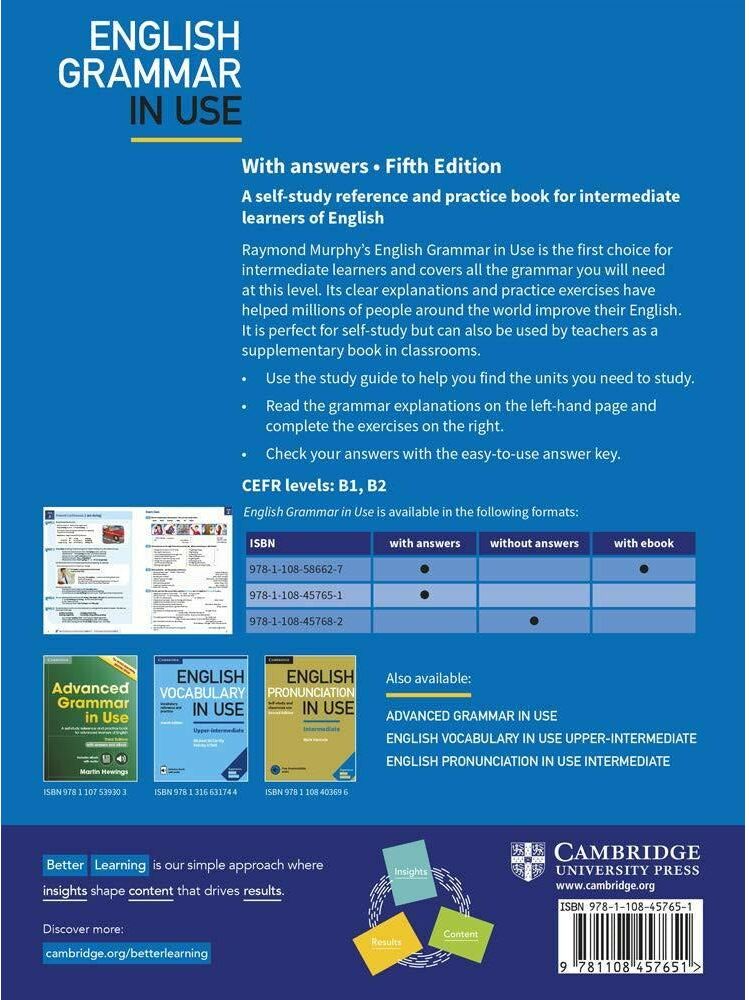
Cambridge University Press English Grammar in Use with Answers by Raymond Murphy – Self-Study Grammar Book for Intermediate LearnersEnglish Grammar in Use with Answers; authored by Raymond Murphy; is the first choice for intermediate (B1-B2) learners and covers all the grammar required at this level. It is a self-study book with simple explanations and lots of practice exercises; and has helped millions of people around the world to communicate in English. It is also trusted by teachers and can be used as a supplementary text in classrooms.12,49 £*Shipping: 2,99 £Secure redirect to the provider
-
Collins Easy Learning Grammar and Punctuation Ages 7-9: Prepare for school with easy home learningDescription. Title :. Grammar and Punctuation Ages 7-9: Prepare for school with easy home learning. Condition: BRAND NEW. Format: Paperback. ISBN: 9780008134228. Combining useful English practice with engaging, colourful illustrations, this Grammar and Punctuation practice book helps to boost your child’s confidence and develop good learning habits for life. Each fun activity is designed to give your child a real sense of achievement.Included in this book:questions that allow children to practise the important skills learned at schoolcolourful activities that make learning fun and motivate children to learn at home helpful tips and answers so that you can support your child’s learning. About the Author:. Colourful and engaging activity books really help children progress at every stage of their learning. With helpful questions and answers, this best-selling range provides reassurance whilst supporting learning at home. Combining useful practice with motivating activities, they help to boost confidence and give children a real sense of achievement.. Title. Grammar and Punctuation Ages 7-9: Prepare for school with easy home learning. Delivery. Content. Reviews3,99 £*Shipping: 2,99 £Secure redirect to the provider



-
What is the correct wording: "Den Lebensmittelpunkt verlegen" or "Den Lebensmittelpunkt verlagern"?
Both "Den Lebensmittelpunkt verlegen" and "Den Lebensmittelpunkt verlagern" are correct wordings in German. However, there is a slight difference in meaning between the two. "Verlegen" implies moving the center of life to a new location, while "verlagern" suggests shifting the center of life to a different area without specifying a new location. **
-
What is the meaning of the expression "den Wind aus den Segeln nehmen"?
The expression "den Wind aus den Segeln nehmen" is a German idiom that translates to "to take the wind out of someone's sails" in English. It means to undermine someone's confidence or momentum, to thwart their plans or efforts, or to deflate their enthusiasm. Essentially, it refers to the act of diminishing someone's advantage or power. **
-
Where does the expression "Das geht den Menschen wie den Leuten" originate from?
The expression "Das geht den Menschen wie den Leuten" originates from the German language and is a common saying used to convey that something applies to everyone in the same way. It is often used to emphasize that a situation or experience is universal and affects people equally. The origin of the expression is not definitively known, but it has been used in German language and literature for many years. **
-
Is it "Ich habe den Fernseher eingeschaltet" or "Ich habe den Fernseher eingeschalten"?
The correct phrase is "Ich habe den Fernseher eingeschaltet." The verb "einschalten" is a separable verb, and in the perfect tense, the prefix "ein" is separated from the main verb "schalten" and placed at the end of the sentence. Therefore, the correct past participle form is "eingeschaltet." **


What does "auf den" mean?
"Auf den" is a German prepositional phrase that translates to "on the" in English. It is used to indicate location or direction towards something. For example, "auf den Tisch" means "on the table" and "auf den Boden" means "on the floor." **
Does it say 'Gebt euch den neuen Song' or 'Gibt euch den neuen Song'?
The correct phrase is "Gebt euch den neuen Song." The verb "geben" conjugated for the imperative form in the second person plural is "gebt." This means "Give yourselves the new song." **
Top-Angebote
Products related to Den:
-
Collins Easy Learning Spanish Grammar And Practice: Trusted Support For Learning - Non FictionTitle:. Easy Learning Spanish Grammar and Practice Overview:. Master the essential foundations of Spanish with Easy Learning Spanish Grammar and Practice, a comprehensive non-fiction guide engineered to demystify complex grammar rules while building genuine, usable confidence through targeted exercises. This trusted resource moves well beyond passive reading, offering a structured, interactive pathway for learners to understand the mechanics of the language and immediately apply that knowledge. Ideal for individuals navigating the early stages of language acquisition or solidifying intermediate skills, the book functions as a versatile companion that adapts to varied learning styles and paces. By pairing clear, jargon-free explanations with practical application tasks, it ensures that every grammatical concept transforms into functional competence. The content covers critical areas such as verb conjugations, sentence syntax, noun agreement, and descriptive structures, presenting them in a logical sequence that reinforces memory retention. Readers benefit from a design that prioritises clarity over complexity, stripping away intimidating linguistic terminology in favour of straightforward insights that get straight to the point. As a standalone volume, it provides everything needed to tackle the challenges of Spanish grammar independently, making it a highly efficient choice for self-motivated students seeking reliable support for their studies. What Makes This Book Stand Out:. The standout feature of Easy Learning Spanish Grammar and Practice is its relentless integration of the "practice" promise directly into the learning flow. Unlike reference manuals that relegate exercises to the back, this book embeds practice questions seamlessly alongside explanations, allowing readers to test their understanding instantly and receive immediate feedback within the context of each topic. This active recall methodology significantly enhances long-term retention compared to traditional review habits. Furthermore, the book employs an effective scaffolding approach; new rules are introduced only after core principles are secure, preventing cognitive overload and ensuring a steady buildup of competence. The layout further distinguishes itself through high readability standards, featuring generous spacing, helpful navigation aids, and a presentation that respects the learner's time. The text also shines in its ability to contextualise grammar, showing how abstract rules translate into real-world communication, thereby bridging the gap between academic theory and spoken fluency. This balanced focus on both mechanical accuracy and communicative utility gives the book exceptional versatility. It serves equally well as a primary study textbook, a rapid-reference guide for assignment preparation, and a durable portfolio piece that grows more valuable with every chapter reviewed. Who This Book Is Perfect For:. Easy Learning Spanish Grammar and Practice caters to a...12,99 £*Shipping: 2,99 £Secure redirect to the provider
-
Porch & Den Wade LoveSeatAmazing, affordable style arrive in the form of this easy-care faux Leather loveseat. Constructed of high performance easy-clean antimicrobial upholstery that is as subtle and it is durable, this loveseat is alluringly designed with a contemporary...728,49 $*Shipping: 0,00 $Secure redirect to the provider
-
Spelling and Vocabulary practice activities for children ages 6-7 (Year 2). Perfect for Home Learning.: (Scholastic English Skills)Master spelling and vocabulary and build English skills This workbook supports children to develop their spelling and vocabulary skills through fun and engaging activities which will help motivate your child's learning and confidence. A progress chart is also included for children to colour in as chapters are completed, and an introduction chapter on how to use the book. Content is split into: Back to basics; New spellins work: consonants; Focus on vowel sound; Super suffixes; More suffixes; Homophones and tricky words; and Spelling words with apostrophes. Help children feel prepared, capable and ready to tackle new challenges at school. Use at home or in school. Quickly builds confidence through regular, achievable activities that encourage independent learning. Designed to complement the school curriculum, meaning children work at the right level, so nothing feels too hard or too easy. Includes extra notes and tips to reinforce skills.4,99 £*Shipping: 1,99 £Secure redirect to the provider
-
What does "den Nagel auf den Kopf treffen" mean?
"Den Nagel auf den Kopf treffen" is a German idiom that translates to "to hit the nail on the head" in English. It is used to describe a situation where someone has made a very accurate or precise statement or observation. It signifies that someone has expressed a thought or idea in a way that perfectly captures the essence of a situation or problem. **
-
Does it say "von Montag den" or "vom Montag den"?
The correct phrase is "von Montag den." This is because "von" is a preposition meaning "from," and "Montag" is the day of the week. When combined, they form the phrase "von Montag den," meaning "from Monday the." On the other hand, "vom" is a contraction of "von dem," which would not be used in this context. **
-
What is the correct wording: "Den Lebensmittelpunkt verlegen" or "Den Lebensmittelpunkt verlagern"?
Both "Den Lebensmittelpunkt verlegen" and "Den Lebensmittelpunkt verlagern" are correct wordings in German. However, there is a slight difference in meaning between the two. "Verlegen" implies moving the center of life to a new location, while "verlagern" suggests shifting the center of life to a different area without specifying a new location. **
-
What is the meaning of the expression "den Wind aus den Segeln nehmen"?
The expression "den Wind aus den Segeln nehmen" is a German idiom that translates to "to take the wind out of someone's sails" in English. It means to undermine someone's confidence or momentum, to thwart their plans or efforts, or to deflate their enthusiasm. Essentially, it refers to the act of diminishing someone's advantage or power. **
Similar search terms for Den
-
Cambridge University Press English Grammar in Use with Answers by Raymond Murphy – Self-Study Grammar Book for Intermediate LearnersEnglish Grammar in Use with Answers; authored by Raymond Murphy; is the first choice for intermediate (B1-B2) learners and covers all the grammar required at this level. It is a self-study book with simple explanations and lots of practice exercises; and has helped millions of people around the world to communicate in English. It is also trusted by teachers and can be used as a supplementary text in classrooms.12,49 £*Shipping: 2,99 £Secure redirect to the provider
-
Collins Easy Learning Grammar and Punctuation Ages 7-9: Prepare for school with easy home learningDescription. Title :. Grammar and Punctuation Ages 7-9: Prepare for school with easy home learning. Condition: BRAND NEW. Format: Paperback. ISBN: 9780008134228. Combining useful English practice with engaging, colourful illustrations, this Grammar and Punctuation practice book helps to boost your child’s confidence and develop good learning habits for life. Each fun activity is designed to give your child a real sense of achievement.Included in this book:questions that allow children to practise the important skills learned at schoolcolourful activities that make learning fun and motivate children to learn at home helpful tips and answers so that you can support your child’s learning. About the Author:. Colourful and engaging activity books really help children progress at every stage of their learning. With helpful questions and answers, this best-selling range provides reassurance whilst supporting learning at home. Combining useful practice with motivating activities, they help to boost confidence and give children a real sense of achievement.. Title. Grammar and Punctuation Ages 7-9: Prepare for school with easy home learning. Delivery. Content. Reviews3,99 £*Shipping: 2,99 £Secure redirect to the provider
-
Porch & Den Meadowbrook Distressed Area RugTie your contemporary or transitional living room together with this versatile area rug. With a color palette and pattern inspired by natural stone, this lightly distressed area rug is earthy yet modern.172,99 $*Shipping: 0,00 $Secure redirect to the provider
-
Where does the expression "Das geht den Menschen wie den Leuten" originate from?
The expression "Das geht den Menschen wie den Leuten" originates from the German language and is a common saying used to convey that something applies to everyone in the same way. It is often used to emphasize that a situation or experience is universal and affects people equally. The origin of the expression is not definitively known, but it has been used in German language and literature for many years. **
-
Is it "Ich habe den Fernseher eingeschaltet" or "Ich habe den Fernseher eingeschalten"?
The correct phrase is "Ich habe den Fernseher eingeschaltet." The verb "einschalten" is a separable verb, and in the perfect tense, the prefix "ein" is separated from the main verb "schalten" and placed at the end of the sentence. Therefore, the correct past participle form is "eingeschaltet." **
-
What does "auf den" mean?
"Auf den" is a German prepositional phrase that translates to "on the" in English. It is used to indicate location or direction towards something. For example, "auf den Tisch" means "on the table" and "auf den Boden" means "on the floor." **
-
Does it say 'Gebt euch den neuen Song' or 'Gibt euch den neuen Song'?
The correct phrase is "Gebt euch den neuen Song." The verb "geben" conjugated for the imperative form in the second person plural is "gebt." This means "Give yourselves the new song." **
* All prices are inclusive of VAT and, if applicable, plus shipping costs. The offer information is based on the details provided by the respective shop and is updated through automated processes. Real-time updates do not occur, so deviations can occur in individual cases. ** Note: Parts of this content were created by AI.